
What should I do before bed to improve sleep?
Your Brain vs. Your Bed: How to Wind Down Before Sleep
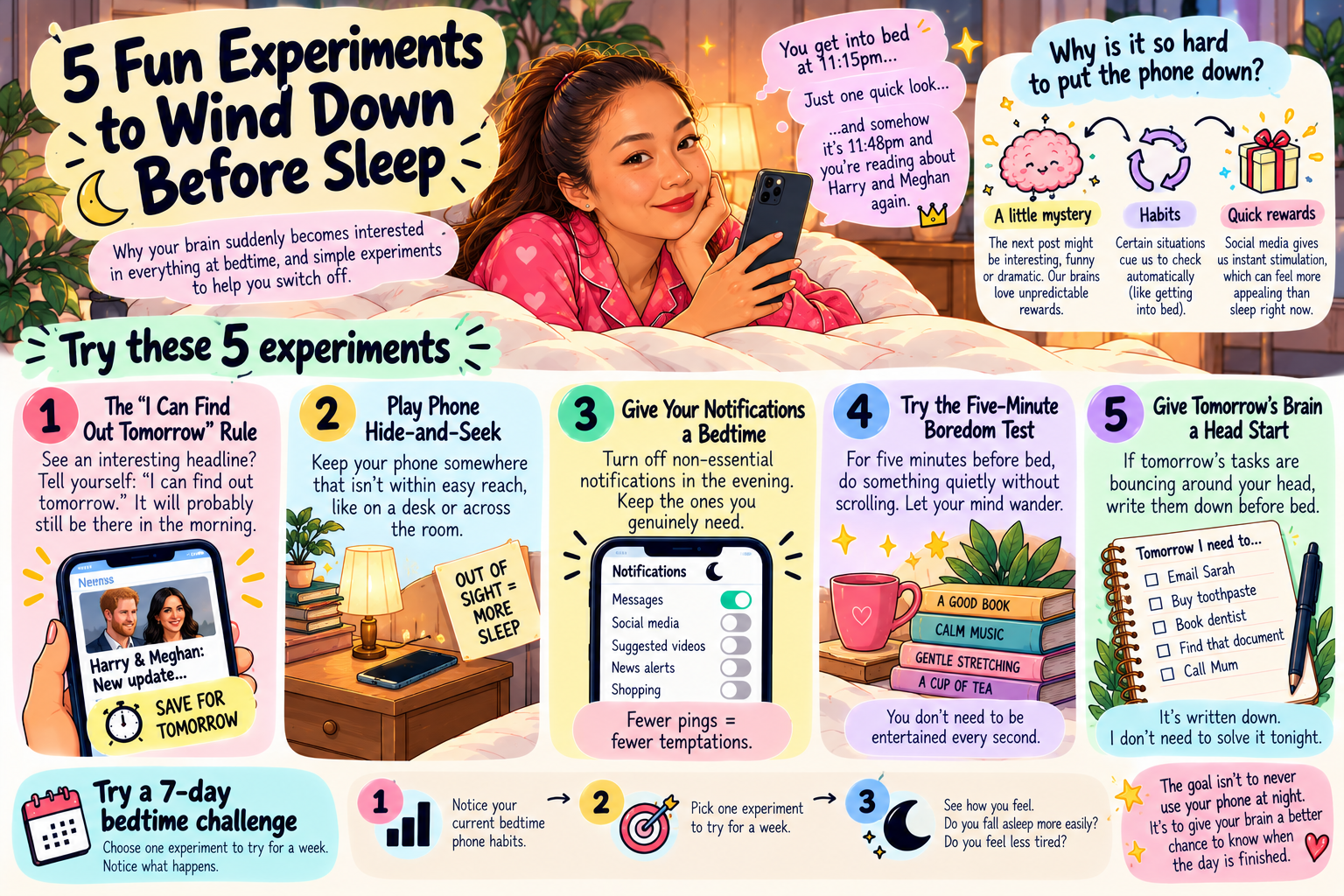
You get into bed at 11:15pm.
You're tired.
Very tired.
Then you remember you haven't checked your phone.
Just one quick look.
Five minutes later, you're reading an update about Harry and Meghan. Then you've watched a video about it. Then you've opened the comments because apparently everyone on the internet has an opinion.
You check the time.
11:48pm.
You put your phone down.
Then your brain remembers something else.
Wait. What happened with that other story?
Phone back out.
Sound familiar?
Bedtime has a strange way of becoming the moment your brain suddenly decides it has unfinished business.
You were tired ten minutes ago. Now you're wide awake and deeply invested in something that absolutely could have waited until morning.
So why does this happen?
The answer has something to do with how our brains respond to novelty, rewards, habits, and the transition from being awake to being asleep.
And understanding that can help us make bedtime a little easier without banning phones, deleting every app, or pretending we're the sort of person who enjoys being in bed at 9pm.
Your brain loves a “What happened?”
Imagine someone tells you:
“Nothing interesting happened today.”
Fine.
Now imagine they say:
“You won't believe what happened.”
Suddenly, you want details.
Our brains pay attention to things that are new, uncertain, or socially important. We want to know what happened next.
That's one reason a headline can be so effective at 11:30pm.
You don't know what's behind it yet.
Maybe it's interesting.
Maybe it's ridiculous.
Maybe everyone else already knows.
You have to check.
Social media makes this even easier because every swipe gives you another possibility. The next post might be funny. It might be useful. It might be completely irrelevant.
Or it might contain exactly the thing your brain was hoping to find.
Dopamine plays a role here, but it's often described too simply. It isn't just a “pleasure chemical.” It's involved in motivation, learning, and anticipating rewards.
The important bit is that your brain can learn that checking your phone might lead to something interesting.
And “might” can be enough.
Try this: The next time you feel the urge to check your phone in bed, ask yourself: What am I hoping to find?
Maybe you want information.
Maybe you're bored.
Maybe you're avoiding thinking about tomorrow.
Or maybe your hand just knows what to do before you've consciously decided.
Your bedtime routine can become a habit
Think about what happens when your head hits the pillow.
Phone comes out.
Check Instagram.
Open TikTok.
Read a message.
Check the news.
Look at the time.
Scroll again.
Over time, your brain can learn the connection between getting into bed and reaching for your phone.
This is how habits work.
A familiar situation becomes a cue for a familiar behaviour.
You don't necessarily think:
I would now like to spend 25 minutes looking at things I didn't intend to look at.
You just reach for the phone.
The good news?
You can change the cue.
Try this: For one week, keep your phone somewhere different at bedtime.
It doesn't have to be across the house.
Even putting it on a table rather than beside your pillow can create a small pause between getting into bed and reaching for it.
That pause matters.
Your brain doesn't know that tomorrow exists
There's another reason bedtime scrolling can be so tempting.
The reward is immediate.
You open your phone and something interesting appears within seconds.
Sleep is different.
The reward comes later.
You have to put the phone down, lie there, wait for your brain to settle, and eventually fall asleep.
Our brains often give more weight to rewards that are available right now than benefits that arrive later. This is sometimes called present bias.
Right now, another video looks interesting.
Tomorrow morning, you'll probably wish you'd gone to sleep earlier.
Unfortunately, tomorrow morning doesn't get a vote at 11:47pm.
This is why making the alternative easier can help.
Put a book beside the bed.
Keep a notebook nearby.
Have your pyjamas ready.
Make your bedroom slightly boring.
You don't need to rely entirely on willpower.
Try this: Make the thing you want to do before bed easier to start than scrolling.
If you want to read, leave the book on your pillow.
If you want to write down tomorrow's tasks, leave the notebook beside the bed.
Give your future self a head start.
Your brain needs a transition
Here's something we often forget.
You can't expect your brain to go from:
“What's happening online?”
straight to:
“Goodnight, brain.”
Your body has an internal clock that helps regulate sleep and wakefulness. As evening gets darker, your body begins preparing for sleep, including changes in melatonin.
But bedtime isn't just about light.
What you're doing on your phone matters too.
A calm conversation is different from an argument in the comments.
Reading something predictable is different from watching a dramatic video.
Checking one message is different from falling into a feed with no natural stopping point.
If your last 30 minutes of the day are full of novelty, information, and emotional stimulation, it can be harder to make the mental switch into sleep.
Try this: Give yourself a short transition between scrolling and sleeping.
It could be 20 minutes.
No complicated routine.
Just something quieter and more predictable.
Five experiments to help you wind down
You don't need a perfect bedtime routine.
You don't need to stop using your phone completely.
Let's start smaller.
Think of these as experiments, not rules. Try one, see what happens, and keep what works.
1. The “I Can Find Out Tomorrow” Rule
You see something interesting.
A celebrity story.
A piece of gossip.
A breaking-news headline.
Something you suddenly feel you need to know.
Tell yourself:
I can find out tomorrow.
You're not banning yourself from looking.
You're simply removing the idea that you need to know right now.
Your challenge: The next time you see something interesting after your planned bedtime, leave it until tomorrow.
Your brain may complain.
Let it.
2. Play Phone Hide-and-Seek
Don't sleep with your phone directly beside your head.
Put it somewhere that requires you to make a decision before grabbing it.
Across the room is even better.
The point isn't to make your phone impossible to access.
It's to add a little friction.
When your phone is within arm's reach, checking takes almost no effort.
When you have to get out of bed to retrieve it, there's a moment where you can think:
Do I actually want to do this?
Your challenge: Keep your phone somewhere you can't reach from bed tonight.
See how many times you still feel the urge to get it.
3. Give Your Notifications a Bedtime
Does your phone really need to tell you about every like, suggested video, trending story, and comment at 11:30pm?
Probably not.
Notifications can act as cues.
Your phone lights up.
You wonder what happened.
You check.
And suddenly you're no longer winding down.
Try switching off non-essential notifications in the evening.
Keep the things you genuinely need.
Let the rest wait.
Think of it as putting your phone on a tiny bedtime curfew.
Your challenge: Turn off unnecessary social media notifications for one evening and see whether you check your phone less.
4. Try the Five-Minute Boredom Test
This one might feel surprisingly difficult.
For five minutes before bed, do nothing particularly exciting.
No scrolling.
No checking headlines.
No jumping between apps.
Just sit somewhere comfortable.
Let your mind wander.
You don't need to meditate.
You don't need to achieve perfect inner peace.
You just need to give your brain a few minutes without a constant stream of new information.
At first, you might feel bored.
That's okay.
Your brain doesn't need to be entertained every second.
Your challenge: Give yourself five minutes of deliberately boring time before getting into bed.
See what happens.
5. Give Tomorrow's Brain a Head Start
Sometimes the problem isn't your phone.
It's your thoughts.
You get into bed and suddenly remember everything you need to do tomorrow.
Email that person.
Book that appointment.
Buy something.
Remember something.
Worry about something.
Your brain starts running through the list.
Writing things down before bed can help get those thoughts out of your head and onto paper.
You don't need a long journal entry.
Just write down what you need to remember tomorrow.
Your challenge: Before bed, write down the few things your brain keeps reminding you about.
Then tell yourself:
It's written down. I don't need to solve it tonight.
What if you still end up scrolling?
You probably will.
You might put your phone across the room and then get up to retrieve it.
You might turn off your notifications and discover that you can still open the apps manually.
You might promise yourself “five minutes” and somehow end up watching a video about a man restoring a 1970s swimming pool.
That's okay.
Habits don't disappear because you've read one article.
They change through repetition, small adjustments, and noticing what actually triggers the behaviour.
And different things will work for different people.
If keeping your phone away from the bed works brilliantly, keep doing it.
If you always start scrolling when you're stressed about tomorrow, focus on that moment.
If celebrity news is your weakness, try the “I Can Find Out Tomorrow” rule.
You don't have to fix everything at once.
Your seven-day bedtime challenge
Want to make this practical?
Choose one experiment and try it for a week.
Before you begin, notice what usually happens at bedtime.
What time do you get into bed?
How long do you normally spend on your phone?
What do you usually look at?
Then choose one change.
Maybe you'll charge your phone across the room.
Maybe you'll turn off social media notifications after a certain time.
Maybe you'll give yourself 20 minutes without scrolling before bed.
At the end of the week, check in with yourself.
Ask:
- Did I spend less time on my phone before bed?
- Did I fall asleep more easily?
- Did my mind feel calmer when I got into bed?
- Did I wake up feeling any different?
Don't worry about getting a perfect result.
You're looking for useful information.
If something helped, keep it.
If it didn't, try another experiment.
That's the point.
A final thought
You don't need to become someone who never touches their phone after 9pm.
You don't need a perfect nighttime routine.
You don't need to know every detail of tomorrow before you fall asleep.
You just need to give your brain a little less to chase when it's time to wind down.
The next time you're lying in bed and see a fascinating headline, pause.
Ask yourself:
Do I actually need to know this tonight?
Maybe you do.
Probably not.
The story will still be there tomorrow.
And yes, Harry and Meghan can wait.
The goal isn't to spend your evenings avoiding your phone. It's to give your brain a better chance to know when the day is finished.