
How to Spend Less Time on Social Media?
Your Brain vs. Your Feed
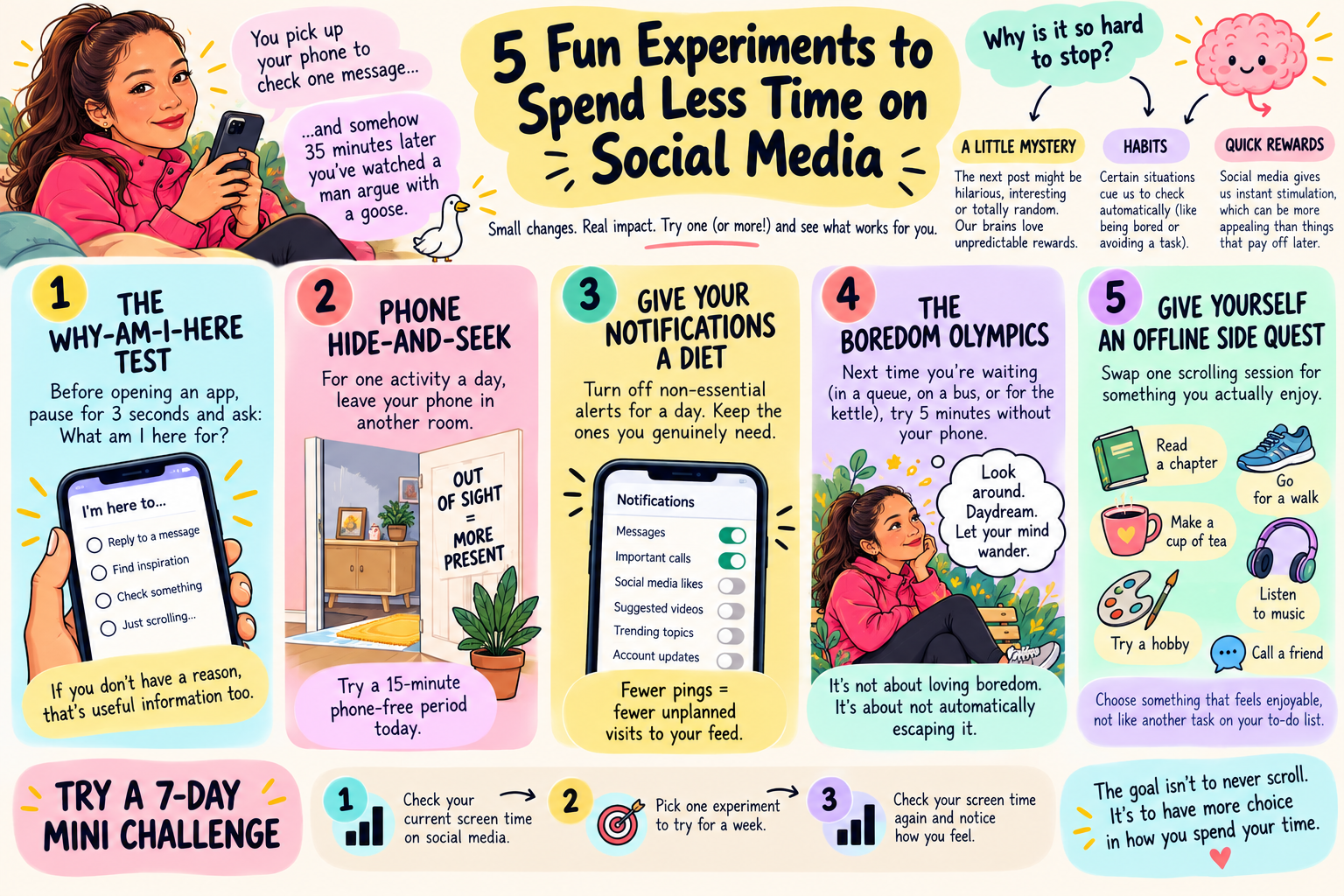
Why we keep scrolling, what our brains have to do with it, and five little experiments to help us take back our time.
You pick up your phone to check one message.
Just one.
Somehow, 35 minutes later, you're watching a stranger renovate a house in Portugal, you've learned three facts about octopuses, and you've seen a recipe for a dessert you'll never make.
Your message? Still unanswered.
Sound familiar?
Social media has a funny way of turning a tiny break into an accidental expedition. You open an app without much thought, start scrolling, and suddenly a perfectly good chunk of your evening has disappeared.
The annoying part is that you might not even be enjoying yourself anymore. You're just… still there.
So why is putting the phone down sometimes harder than it should be?
The answer has something to do with how our brains learn, respond to rewards, and turn repeated actions into habits. And understanding that can help us spend less time scrolling without deleting every app or moving to a cabin in the woods.
Your brain likes a little mystery
Imagine being offered a box of chocolates. You know exactly what you're getting. Lovely.
Now imagine a box that might contain your favourite chocolate, a funny surprise, or a slightly disappointing raisin. You don't know what's inside until you open it.
Suddenly, there's a reason to keep checking.
Social media works in a somewhat similar way. The next post might be hilarious. It might teach you something useful. It might be a photo from someone you haven't seen in years. Or it might be a video of a man arguing with a goose.
You never quite know.
That unpredictability matters because our brains learn from rewards. When something turns out to be more interesting or rewarding than expected, the brain's dopamine system helps update what we learn and what we're motivated to seek again.
Dopamine isn't simply a happiness chemical, and scrolling doesn't automatically produce an addictive chemical rush. It plays a more complicated role in learning, motivation, and anticipating rewards.
The important point is that an unpredictable feed can give us a reason to keep checking. Every swipe offers another possibility.
And possibilities are surprisingly good at keeping us around.
The trouble is that the next post doesn't have to be particularly good. It just has to feel as though it might be.
Try this: Before opening a social media app, ask yourself what you actually want from it. Are you replying to someone, looking for inspiration, or simply hoping something interesting will appear?
There's nothing wrong with any of those reasons. But knowing yours can help you decide when you've had enough.
Bored for four seconds? Check your phone.
Think about the last time you waited for something.
A bus. A kettle. A friend who's running ten minutes late and has apparently entered a different time zone.
What did you do?
If your hand went straight to your phone, you aren't alone.
Over time, our brains learn associations between situations and actions. When you're bored, you check your phone. When a task feels difficult, you check your phone. When you get into bed, you check your phone.
Eventually, you may do it almost automatically.
Psychologists often describe habits in terms of cues and responses. A familiar situation prompts a familiar behaviour, especially when you've repeated that behaviour many times.
You don't necessarily sit there thinking, I would now like to spend 20 minutes scrolling through content chosen by an algorithm.
You just reach for the phone.
This is one reason relying on willpower alone can be frustrating. You're trying to make a conscious decision while surrounded by cues that have trained you to act without much thought.
The good news? You can change the situation around the habit.
Try this: Notice the moments when you automatically reach for your phone. Don't try to fix everything at once. Just spot the pattern.
Maybe it's whenever you feel bored. Maybe it's when you need to start a task you don't particularly want to do. Maybe it's the moment your head touches the pillow.
Once you know the cue, you have somewhere to start.
Your future self would like a word
Here's another reason we keep scrolling: the reward is immediate.
A funny video takes seconds to deliver. A good book takes longer to get into. Going for a walk requires putting on shoes, finding your keys, and negotiating with the weather.
Our brains often favour rewards available right now over benefits that arrive later. This tendency is commonly called present bias.
You know you'd probably feel better after getting some fresh air, finishing a chapter, or finally tackling that little task you've been avoiding. But right now, another video looks considerably more appealing.
Your present self wants entertainment.
Your future self would quite like to have done something else with the evening.
Unfortunately, your future self doesn't get a vote until tomorrow.
This doesn't mean you're lazy or lack discipline. Immediate rewards are simply easier to choose than distant ones, particularly when you're tired, stressed, or trying to avoid something uncomfortable.
One practical solution is to make the alternative easier to start.
Leave a book beside your bed. Keep your walking shoes near the door. Put your sketchbook on the table instead of in a drawer you haven't opened since last Christmas.
Make the thing you want to do a little more convenient, and make automatic scrolling a little less convenient.
Small changes to your environment can make a surprising difference.
Five experiments to help you scroll less
You don't need a complicated digital detox. You don't need to declare war on your phone.
Let's start smaller.
Think of these as experiments, not rules. Try one, see what happens, and keep what works.
1. The Why-Am-I-Here Test
Before opening an app, pause for three seconds and ask yourself: What did I come here to do?
Maybe you want to reply to a message. Perhaps you're checking the weather someone posted about. Or maybe you're opening Instagram because your thumb seems to have developed a mind of its own.
If you have a reason, carry on.
If you don't, take a moment to decide whether you actually want to scroll.
This little pause won't magically erase a habit. But it creates an opportunity to notice what you're doing before you do it.
Your challenge: Try the three-second pause every time you open your most-used social media app today.
2. Play Phone Hide-and-Seek
For one activity a day, leave your phone in another room.
Eat lunch without it. Read a book without it sitting beside you. Work on something for 20 minutes without the screen lighting up every few moments.
You might be surprised by how often you think about retrieving it.
That's useful information, not a personal failing.
Having your phone nearby makes checking easy. Putting it out of reach introduces a small amount of friction, giving you more opportunity to stay with what you're doing.
Your challenge: Choose one 15-minute period today when your phone stays somewhere you can't casually grab it.
No need to make it a whole lifestyle.
3. Give Your Notifications a Diet
Does your phone really need to announce every like, suggested video, trending topic, and update from an account you followed three years ago?
Probably not.
Notifications can interrupt what you're doing and act as cues to open an app. Even when you ignore them, they can draw your attention towards the phone.
Try turning off non-essential notifications for a day. Keep the alerts you genuinely need, such as important calls or messages.
You can still check your accounts when you choose to. You're simply removing some of the invitations.
Think of it as unsubscribing from the world's least organised newsletter.
Your challenge: Turn off unnecessary social media notifications today and see whether you reach for your phone less often.
4. Enter the Boredom Olympics
Here's a radical idea: the next time you're waiting in a queue, sitting on a bus, or waiting for the kettle to boil, do nothing with your phone for five minutes.
Look around. Daydream. Let your mind wander. Wonder why supermarket queues always seem to move faster in the one you didn't choose.
You don't have to meditate or achieve a state of profound inner peace.
You just have to allow a little space between feeling bored and reaching for a screen.
That pause can help you notice an urge without automatically acting on it. You may still want to check your phone afterwards. That's fine.
The goal isn't to eliminate boredom. It's to discover that you can experience it without immediately reaching for something to fill it.
Your challenge: Choose one ordinary waiting period today and leave your phone in your pocket.
5. Give Yourself an Offline Side Quest
Here's the bit that often gets overlooked when we talk about spending less time online.
What are you going to do instead?
If social media is your easiest source of entertainment, taking it away can leave you feeling restless. Simply telling yourself not to scroll doesn't provide an alternative.
So give yourself a small side quest.
Read a chapter of a book. Try a new recipe. Go for a short walk. Listen to an album without simultaneously checking six other things. Call a friend and have a conversation that doesn't involve sending each other videos every 12 seconds.
Choose something you genuinely enjoy. This isn't an opportunity to replace scrolling with an exhausting list of productive tasks.
You don't have to optimise every spare minute of your life.
Sometimes, making a cup of tea and staring out of the window is a perfectly respectable use of your time.
Your challenge: Replace one scrolling session today with an activity you actually want to do.
What if you still end up scrolling?
You probably will.
You might try the phone-free lunch and then spend 40 minutes scrolling that evening. You might switch off your notifications and discover that you now open the app manually.
Habits don't disappear because you've read one article and had a moment of inspiration.
They change through repetition, adjustments to your environment, and practice. And the approach that works for one person might not work for another.
That's why it's worth treating these ideas as experiments.
Try something. Notice what happens. Adjust it.
If leaving your phone in another room works brilliantly, keep doing it. If you find yourself opening apps whenever a task becomes difficult, focus on that moment instead. If your screen-time statistics show that most of your scrolling happens in bed, start there.
You don't have to fix everything at once.
And don't assume that every minute spent on social media is wasted. These platforms can help us stay connected, learn things, laugh, and find communities we might not encounter otherwise.
The question isn't whether social media is good or bad.
It's whether the time you're spending on it reflects what you actually want.
Your seven-day mini challenge
Want to make this practical? Choose one experiment and try it for a week.
Before you begin, check your phone's screen-time report. Note how much time you spend on social media on an average day.
Then pick one change to practise. Perhaps you'll keep your phone away during meals, switch off non-essential notifications, or stop taking it to bed.
At the end of the week, check your screen time again.
Look at the number, but don't stop there. Ask yourself:
- Did I spend less time scrolling?
- Did I find it easier to concentrate on other things?
- Did I feel more present during any part of my day?
Your screen-time total won't tell you everything. But combined with how you felt, it can help you decide whether the change was worthwhile.
If nothing changed, try a different experiment. That's the point of experimenting.
A final thought
You don't need to become a person who never scrolls.
You don't need to delete every app, buy a basic phone, or develop an intense new relationship with your houseplants.
You just need to notice when scrolling has stopped being a choice and started becoming a reflex.
The next time you reach for your phone, pause for a moment.
Ask yourself what you're looking for.
Then decide.
You might still open Instagram. You might watch a funny video or send your friend a ridiculous meme.
Or you might put the phone down and do something else.
The goal isn't to spend your life avoiding your feed. It's to have a little more say in how you spend your life.